Hyllested Keramik
If you have notes on accuracy, content, site links, or any other requests regarding this page, please get ahold of us at contact@hamiltonandsonsauctions.com.
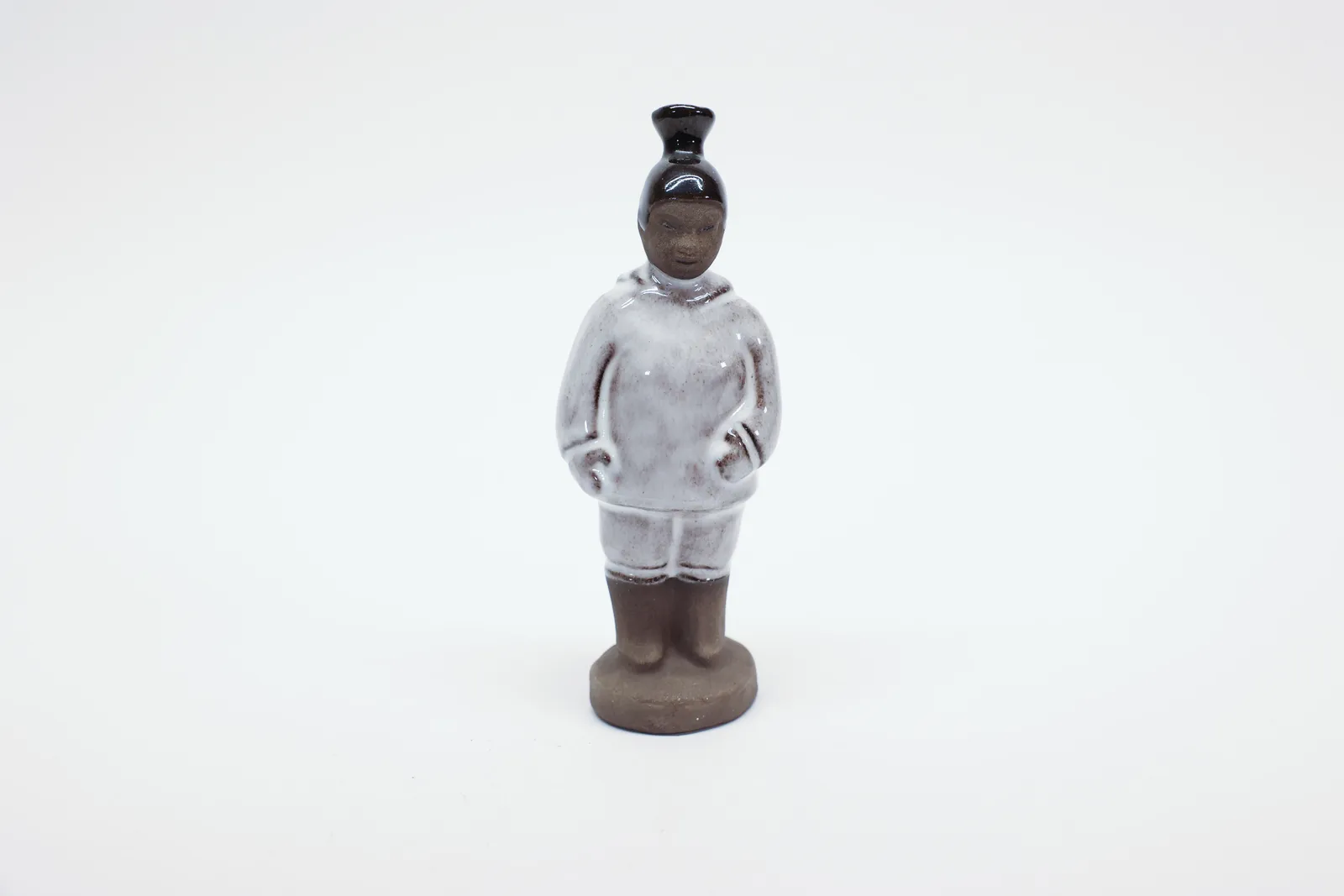
Hyllested Keramik was a Danish studio pottery founded in 1959 by Holger Jensen, who had trained at the renowned Herman A. Kähler ceramics workshop before establishing his own studio; his son, Leif Jensen, later took over the business in 1970. Operating through the mid-twentieth century, the workshop produced hand-thrown stoneware vases, dishes, and, most distinctively, small figural sculptures, all typically marked "Hyllested" or "Hyllested Denmark" on the base.
The studio became particularly known for a series of charming figures depicting Greenlandic Inuit people, often called "Eskimo" figures in period marketing, rendered in a simplified, semi-abstract style with contrasting glazes: unglazed natural stoneware left bare for the face, hands, and feet, set against white or beige glaze representing fur-trimmed parkas and boots, with dark brown or black glaze for the hair. These pieces portray a simple and slightly abstract representation of an eskimo wearing hooded white glazed, possibly bearskin overalls, with the feet and face left in the natural contrasting clay. Companion motifs included polar bears and children from Greenland, reflecting a broader mid-century Danish fascination with Arctic and Inuit imagery.
Hyllested pieces are collected today as representative examples of Danish mid-century studio pottery, valued for their handcrafted quality, distinctive two-tone glazing technique, and the folk-art charm of their Nordic and Greenlandic subject matter. Because output was modest compared to larger factories like Kähler or Royal Copenhagen, well-preserved figures with clear maker's marks remain sought after by collectors of Scandinavian ceramics.
Sources: